How to Hike the Atlas & Sleep in the Sahara in one Trip
Seven days earlier, you were standing on a limestone ridge at 2,900 metres, watching the sun rise over the Central High Atlas. The air was thin and cold, and the only sound was your own breathing and the distant clatter of mule hooves on rock. Tonight, you are lying on your back on a sand dune in the Sahara, watching the Milky Way turn slowly overhead while a campfire crackles somewhere behind you. Two landscapes. Two climates. Two worlds. All in one trip. This is the Morocco trek and desert combo — and it is one of the most rewarding travel experiences North Africa has to offer.
The idea is simple: spend the first half of your trip trekking through the High Atlas Mountains, crossing passes above 2,900 metres, sleeping in Berber guesthouses, and walking through valleys that have been farmed for a thousand years. Then transfer south to the Sahara for two nights on the Erg Chebbi dunes — camel treks at sunset, nights in a desert camp, and the kind of silence that only exists where there are no roads. If you are looking for an Atlas + Sahara trek that combines genuine mountain walking with desert magic in a single seamless itinerary, this guide is for you. We cover the route day by day, what to pack for two climates, what it costs, whether to go private or shared, and real reviews from people who have done this exact trip with us.
We are Morocco Desert Gateway. We built our 8-day M’Goun Valley + Merzouga tour specifically for travellers who want both worlds, and we have been running it long enough to know exactly where the transitions work and where they do not.
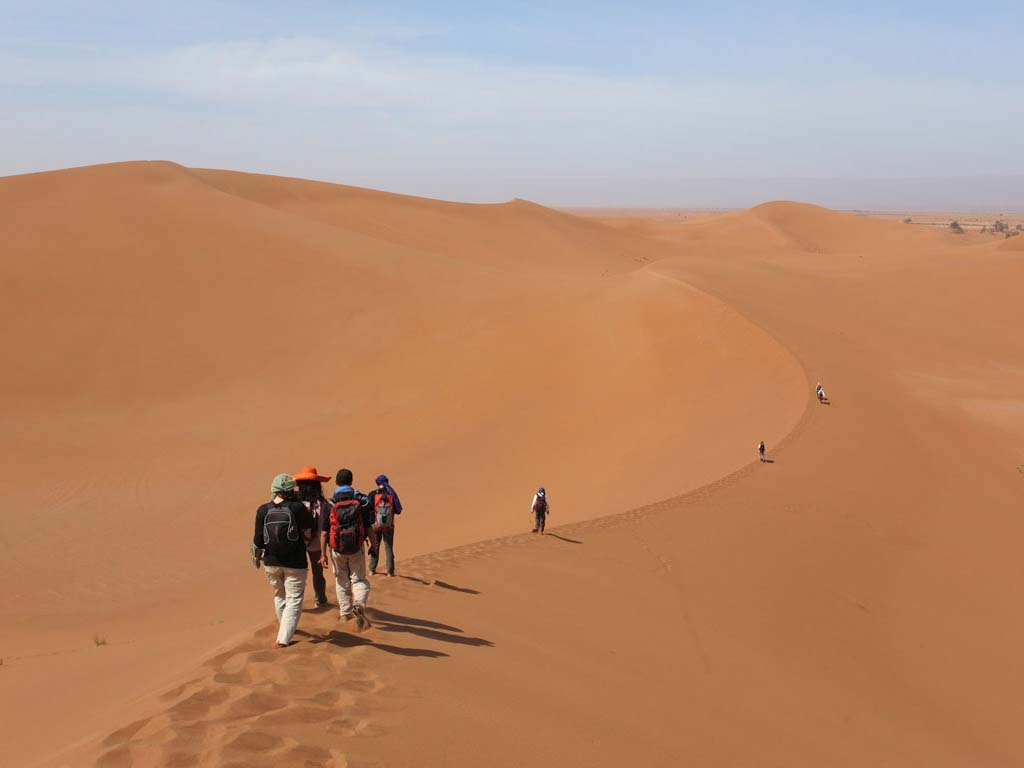
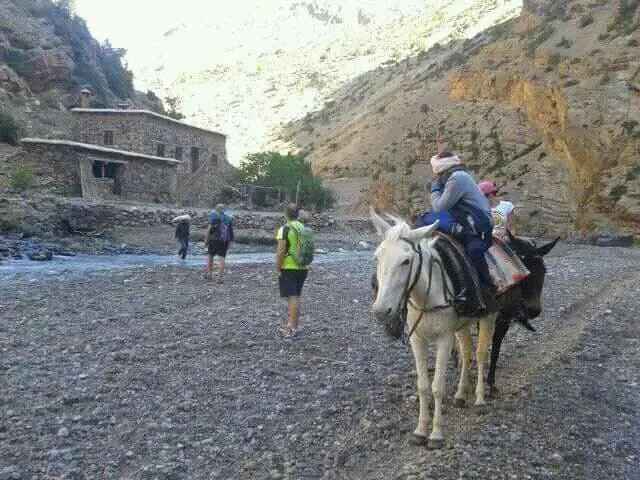
Table of Contents
- Why Combine the Atlas Mountains and the Sahara?
- The Perfect Itinerary: Marrakech to M’Goun to Merzouga
- Practical Tips: Budget, Packing, Visas
- Private vs. Group Tours for This Route
- Real Traveler Reviews
- Frequently Asked Questions
Why Combine the Atlas Mountains and the Sahara?
The short answer is contrast. Morocco is one of the few countries in the world where you can sleep at 1,850 metres in a Berber village one night and wake up in a Sahara desert camp 48 hours later. The drive between the two takes less time than you think — roughly five hours from the M’Goun Gorge exits to the dunes of Merzouga — and the transition is part of the experience.
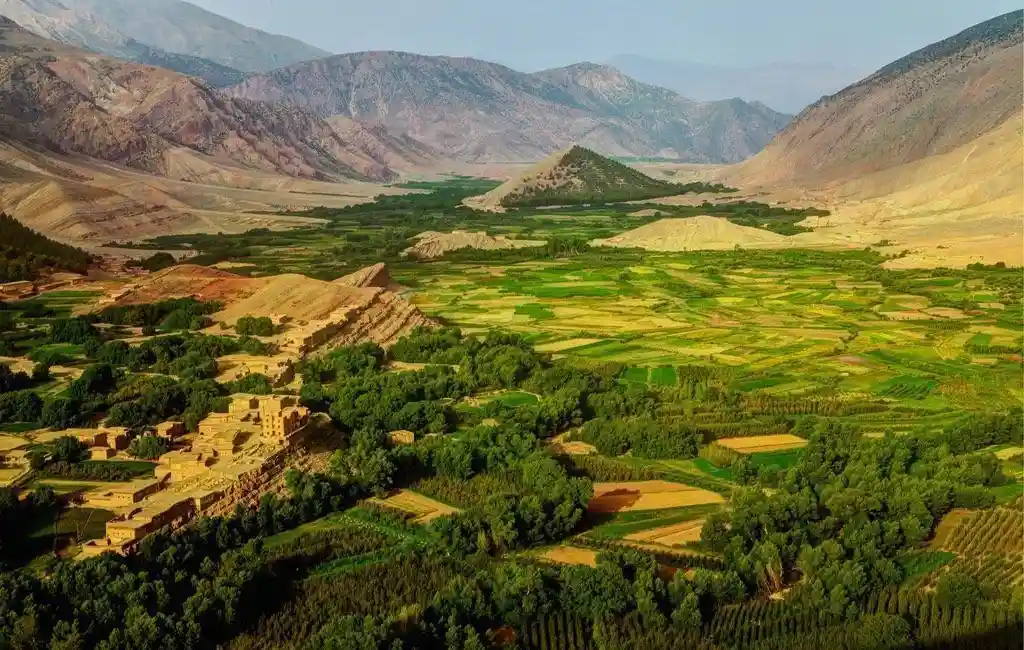
The Atlas Mountains are green and brown. They smell of walnut trees, woodsmoke, and damp earth after rain. The trails follow rivers through narrow gorges, and every village has a spring and a mosque painted white. The Sahara is beige and gold and orange. It smells of dust and sun-baked clay. The roads are straight and empty, and the dunes rise from the flat landscape like frozen waves.
On a Morocco trek and desert combo, you get the full sensory range. You experience the physical challenge of a high-altitude trek — the lungs working, the legs burning, the satisfaction of reaching a pass and seeing the valley open below — and then you descend into the desert for the reward: sitting on a dune at sunset with a glass of mint tea, watching the sand change colour minute by minute.
Most travellers who attempt to combine the two go wrong by trying to do too much. They cram Toubkal, the Dades Gorge, Merzouga, and Marrakech into five days. The result is a blur of transfers, missed connections, and fatigue. Our approach is to focus on one mountain range — the M’Goun Massif — and one desert destination — Erg Chebbi — and give each enough time to breathe. That is what makes this Atlas + Sahara trek work: depth over breadth.
The Perfect Itinerary: Marrakech to M’Goun to Merzouga
This is the exact itinerary of our 8-Day M’Goun Valley Trek & Merzouga Desert Tour from Marrakech. It is designed to balance trekking intensity with comfortable transitions, and it has been refined over years of feedback from guests.
Day 1 — Marrakech to Ouzoud Waterfalls to Aït Bouguemez Valley
You depart Marrakech at 8:00 AM. The first stop is Ouzoud Waterfalls — 110 metres of water dropping over red cliffs into a pool surrounded by olive trees. A local guide walks you down through the groves. Barbary macaques watch from the branches. A boat ride at the base of the falls sends spray across your face, and for a moment the heat of the city feels very far away.
After lunch, the road climbs into the High Atlas proper. The asphalt narrows, switchbacks appear, and the landscape shifts from arid foothills to the green terraces of the Aït Bouguemez Valley — the “Happy Valley.” You arrive at your guesthouse in the village of Arouss as the light turns gold. Dinner in a Berber home. Mint tea. The first night of silence.
Driving: 5 hours total including lunch at the falls.
Altitude: 1,850 m.
Day 2 — Arouss to Sidi Moussa to Timit to Tabant
The trek begins. You walk through farmland where the irrigation channels are still made of hollowed tree trunks. The trail passes the Sidi Moussa granary — a fortified stone building where the villagers still store grain the way their grandparents did. A short climb to the hill of Timit gives you your first panoramic view of the valley. In the distance, the M’Goun Massif rises like a wall.
You arrive in Tabant — the main village of the Aït Bougmez Valley — in the early afternoon. Time to wash, rest, and walk through the village market if it is a Thursday. The guesthouse has a rooftop terrace where you can watch the sunset over the valley.
Walking: 5 hours / ~12 km.
Altitude: 1,850 m.
Day 3 — Tabant to Tizi n’Aït Imi Pass (2,900 m) to Ouzighimte
This is the big day. You leave after an early breakfast, climbing steadily through terraced fields and then into open mountain terrain. The trail to Tizi n’Aït Imi Pass gains about 1,000 vertical metres over four hours. The switchbacks are steady but not brutal, and your guide sets a pace that lets you breathe.
At the pass (2,900 m), the world opens in both directions. North, the Aït Bougmez Valley. South, the M’Goun Gorge and the faint blue line that marks the Sahara beyond. You eat lunch on the ridgeline.
The descent to Ouzighimte is gentle — a long traverse through juniper trees and rock formations that look like they were stacked by hand. Ouzighimte is a tiny village of seven houses. You sleep in a family gîte, and the children will likely gather outside the door to stare at the foreigners until someone’s mother calls them in for dinner.
Walking: 6 hours / ~14 km.
Max altitude: 2,900 m.
Day 4 — Ouzighimte to Canyon to Aguerzega
Today is about gorges. The trail drops into a canyon system where the walls close in and the river runs over polished stone. In spring, you cross the stream multiple times. In autumn, the bed is dry and you walk along the pebbled floor, watching the canyon walls change colour as the sun moves overhead.
Aguerzega is a cluster of stone houses at the canyon exit. Dinner with the family. More mint tea. More stars.
Walking: 5 hours / ~13 km.
Altitude: 1,700 m.
Day 5 — Aguerzega to Magic Valley to Boutaghrar
The Magic Valley gets its name from the rock formations — layered sandstone and limestone that erode into shapes that look like castles, faces, and abstract sculptures. The colours shift from red to ochre to grey depending on the angle of the light. This section of the trek is the most photographed, and for good reason.
You reach Boutaghrar (also spelled Bou Tharar) in the late afternoon. The village sits at the edge of the M’Goun Gorge, and the view south opens across the Dades Valley toward the desert. This is your last night in the mountains.
Walking: 5.5 hours / ~14 km.
Altitude: 1,600 m.
Day 6 — Boutaghrar to Todra Gorge to Erfoud to Merzouga
The transition day. After breakfast, you transfer by vehicle south toward the Sahara. The first stop is Todra Gorge — a canyon where the limestone walls rise 300 metres on either side, barely 10 metres apart at the narrowest point. You walk through the gorge for an hour, craning your neck at the rock climbers on the walls above.
Lunch in Tinjdad. Then the landscape begins to flatten. The road runs straight through the palm groves of the Draa Valley. By late afternoon, the dunes of Erg Chebbi appear on the horizon.
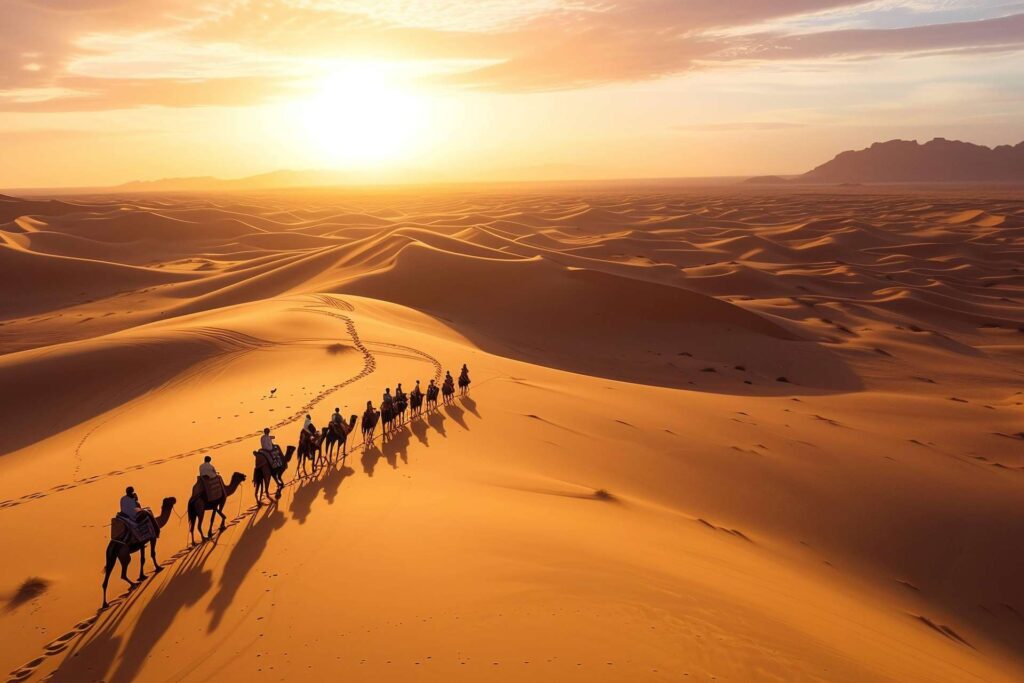
You arrive in Merzouga. A camel awaits you. You mount up and ride into the dunes as the sun begins to drop. The camels sway and grumble. The sand is warm underfoot. At the camp, you climb the nearest dune and watch the sunset turn the desert red, then purple, then indigo. Dinner in a luxury tent. Music around the fire. Sleep under a canopy of stars so dense they look like white paint splattered across black paper.
Driving: 4 hours.
Walking: 1 hour in the Todra Gorge + 1 hour camel trek.
Day 7 — Merzouga to Draa Valley to Aït Ben Haddou
Wake at dawn. Climb the dune behind your camp and watch the sunrise paint the sand in the opposite direction. After breakfast, ride the camel back to Merzouga village. You could also take a 4×4 if your knees object to the camel’s gait — no judgment.
The drive west follows the Draa Valley — Morocco’s longest palm oasis. The road runs through a green corridor of date palms that stretches for nearly 200 kilometres, punctuated by ruined kasbahs, mud-brick villages, and the occasional shepherd crossing the road with a herd of goats.
You arrive at Aït Ben Haddou in the late afternoon — the UNESCO World Heritage ksar that has appeared in more films than most actors. You walk through the narrow alleys, climb to the top of the granary, and watch the sunset turn the mud-brick walls copper. Dinner in a guesthouse across the river.
Driving: 5 hours.
Altitude: 1,200 m.
Day 8 — Aït Ben Haddou to Tizi n’Tichka Pass to Marrakech
The final drive. You cross the High Atlas via the Tizi n’Tichka Pass at 2,260 metres, with scenic stops at viewpoints that look out across the mountain ranges you trekked through five days earlier. You arrive in Marrakech in the early afternoon. The medina feels loud and crowded after the silence of the mountains and desert. You shower, change, and start planning your next trip before you have even unpacked.
Driving: 4 hours.
Practical Tips: Budget, Packing, Visas
What this costs
The 8-Day M’Goun Valley Trek & Merzouga Desert Tour starts at €1,050 per person for shared group tours. This includes all transfers, a licensed mountain guide, mules and muleteers for the trekking days, accommodation in guesthouses and the desert camp, camel trek, all breakfasts and dinners, and lunches on trekking days. It does not include flights, travel insurance, tips, drinks, or lunches on transfer days.
Private tours cost more — roughly €1,400–1,800 depending on group size — but you get your own guide, flexible start times, and the ability to tweak the itinerary. For a Morocco trek and desert combo of this length and complexity, the pricing is competitive. You are paying for real expertise: guides who know the M’Goun trails by heart, not by GPS, and a support team that handles logistics so you only carry a daypack.
Packing for two climates
This is the question we get most often. You need gear for alpine conditions (cold nights, possible rain, rocky terrain) and desert conditions (hot days, cold nights at camp, sand). Here is what works:
Footwear: Hiking boots, broken in, with ankle support. For the desert part, you can switch to trainers or sandals — but bring the boots for the mountain days. One pair is fine if they are comfortable.
Clothing: A waterproof jacket (mandatory — the Atlas can rain even in summer). A fleece or mid-layer for cold mornings at altitude. A warm hat and gloves if trekking before May or after September. Otherwise, lightweight hiking shirts and trousers. In the desert, a scarf for the camel ride — the wind picks up sand, and you will be grateful for something to wrap around your face.
Sleeping bag: Rated to 0 °C. Guesthouses and the desert camp provide blankets, but a good sleep bag makes the difference between a comfortable night and a cold one.
Headlamp: Power outages in guesthouses are normal. The desert camp has no electricity after the generator goes off. A headlamp is not optional.
Sun protection: Sunscreen, sunglasses, a wide-brimmed hat. The sun in the Anti-Atlas and Sahara is stronger than you expect. Reapply at lunch.
Water bottle: 1.5-litre capacity minimum. Your guide carries extra water, but you need to carry your own during the walking days.
The golden rule: Pack light. Your main bag goes on the mules during the trekking days, but you carry a daypack (5–8 kg) on the trail. Anything you do not absolutely need, leave in Marrakech.
Visas
Most nationalities (EU, UK, US, Canada, Australia, New Zealand) do not need a visa for Morocco for stays under 90 days. Your passport must be valid for at least six months from the date of entry. Check your specific country’s requirements before booking.
Private vs. Group Tours for This Route
This is not a question with a single right answer. It depends on your priorities.
Shared Group Tour
You join a small group of up to 12 people. The itinerary is fixed. The pace is set by the group’s average fitness level. You share meals, tents, and stories. The cost is lower — the €1,050 price point makes it accessible for solo travellers and budget-conscious couples. The social dynamic can be excellent: we have seen solo travellers become friends who plan their next trip together.
Best for: Solo travellers, budget-conscious couples, people who enjoy meeting other travellers.
Private Tour
You travel with your own group — even if that group is just you and your partner. The itinerary is flexible. If you need an extra rest day, you take it. If you want to walk faster or slower, you set the pace. You have the guide’s full attention. You can combine it with a stay in Marrakech before or after the trek. The cost is higher, but the experience is tailored.
Best for: Couples seeking privacy, families, anyone with specific fitness or pacing requirements, travellers who prefer a dedicated experience.
Our recommendation for this specific route
For the Atlas + Sahara trek, we recommend private for most couples and groups of 2–4. Why? Because the combo route involves two very different experiences — mountain trekking and desert relaxation — and having a private guide lets you manage the transition on your own terms. You are not waiting for others to pack their bags. You stop when you want to take photos. You linger over dinner instead of sticking to a schedule.
If your budget is tighter or you are travelling solo, the shared group option is excellent. The groups are small, the guides are the same, and the route is identical. The difference is flexibility, not quality.
Real Traveler Reviews
Here is what guests who have done this Morocco trek and desert combo actually said. No editing. No marketing polish.
Daniel K. — Solo trekker, Norway
“I have done the Toubkal summit three times with different companies. M’Goun with Morocco Desert Gateway was something else entirely. No crowds. No fixed camps with forty tents in a row. Just the mountain, our guide, and six days that felt genuinely remote. The valley crossing on day four alone was worth the entire flight to Morocco. Then we went to Merzouga and the desert camp was the perfect contrast — a reward, not just another destination. I told my guide, ‘I think this is the best trip I have done in Morocco.’ He just smiled and poured more tea.”
Sophie & Lena B. — Two friends, Belgium
“We specifically searched for a company that did not just run the Merzouga loop like everyone else. Morocco Desert Gateway took us through N’Kob — places we would never have found alone. Ancient kasbahs, an oasis walk at sunrise, a family guesthouse that was not on any app. Then the desert part was the cherry on top. The camel trek at sunset was exactly as beautiful as you imagine. We came back with photos nobody else has. That feeling of having found something real.”
Patrick G. — Group of 4, Ireland
“Four of us, all in our late 40s, wanted something more demanding than the usual desert loop. The M’Goun trek was exactly that — long days on the trail, Berber guesthouses instead of tourist lodges, and a guide who treated us like adults capable of handling real terrain. We finished the summit on day six and honestly felt like we had earned something. The drive down to Merzouga after the trek felt like a victory lap. Brilliant. Would do it again tomorrow.”
Frequently Asked Questions
Can I really do both mountains and desert in 8 days?
Yes, and without feeling rushed. The first five days are the trekking portion (M’Goun Valley, Aït Bougmez, canyons, and mountain passes). Days six to eight cover the desert — Merzouga dunes, Todra Gorge, Draa Valley, and Aït Ben Haddou. The transition day (Day 6) includes a short walk in Todra Gorge and a camel ride at sunset — active but not exhausting.
Is this trek suitable for someone who has never done multi-day hiking?
It depends on your fitness. The walking days are 5–6 hours on uneven terrain with altitude up to 2,900 metres. If you are active — regular hill walking, gym cardio, or sport — you can manage it. If you are sedentary, we recommend building up with 8 weeks of training beforehand. The desert section requires no fitness preparation beyond being comfortable in a car for five hours.
What is the accommodation like during the trek?
You sleep in family-run Berber guesthouses (gîtes d’étape) for the mountain portion. These are simple: shared bathrooms, foam mattresses, home-cooked meals. The desert camp is more comfortable — proper beds, private tents, hot showers, and a full dinner. The contrast between the two is deliberate: you earn the comfort of the desert camp by walking through the mountains first.
Will I have phone signal on the trail?
In the Aït Bougmez Valley and villages, yes — patchy 3G/4G on Moroccan networks (Maroc Telecom works best). Above 2,000 metres and in the canyons, no. The desert camp has no signal. This is a feature, not a bug. Tell your family you will be offline for 48 hours and enjoy it.
What happens if I get altitude sickness?
The highest point is Tizi n’Aït Imi Pass at 2,900 metres. Altitude sickness is rare below 3,000 metres, but it can happen. Your guide carries a first aid kit, knows the symptoms, and will descend with you if needed. The itinerary is designed with a gradual ascent — you spend two nights at 1,850 m before climbing to 2,900 m — which minimises risk.
Can I extend the trip to include Fes or Chefchaouen?
Yes. The standard tour starts and ends in Marrakech, but we can arrange an extended itinerary that continues north after the desert drop you in Fes instead of returning to Marrakech. This adds 2–3 days and requires a separate booking.
Do I need travel insurance?
Yes. We require all guests to have comprehensive travel insurance that covers trekking at altitude (up to 3,000 m) and emergency evacuation. This is non-negotiable. Standard travel insurance often excludes mountain activities — check your policy before booking.
What makes this different from a standard Morocco tour?
Most Morocco tours that claim to combine the Atlas and Sahara involve a scenic drive through the mountains and a night in the desert, with all meals in tourist restaurants and no real walking. This is a genuine trekking experience — you cross a mountain pass at 2,900 metres on foot, sleep in Berber homes that have no website, and reach the desert as the culmination of a journey, not as a photo stop.
Conclusion
A Morocco trek and desert combo is not a compromise between two experiences. It is the best possible way to understand what this country offers in a single trip. The mountains give you challenge, silence, and the slow satisfaction of moving through a landscape on foot. The desert gives you space, light, and a kind of peace that is hard to find anywhere else. Together, they form a complete picture of Morocco — a place where geology, culture, and history converge in landscapes that change faster than you expect.
We built the 8-day M’Goun Valley Trek & Merzouga Desert Tour for exactly this purpose. Not as a checklist of sights, but as a journey with a beginning, middle, and end — from the walnut groves of the Happy Valley to the dunes of Erg Chebbi, with a Berber guide who grew up between them.
Ready to book your Atlas + Sahara trek?
Browse our 8-Day M’Goun Valley Trek & Merzouga Desert Tour for full details, pricing, and availability. Or contact us to arrange a private departure with your own dates.
→ Explore all Morocco Trekking Tours
→ See our Sahara Desert Tours