M’Goun Trek Morocco: The Complete 2026 Guide to Hiking the High Atlas
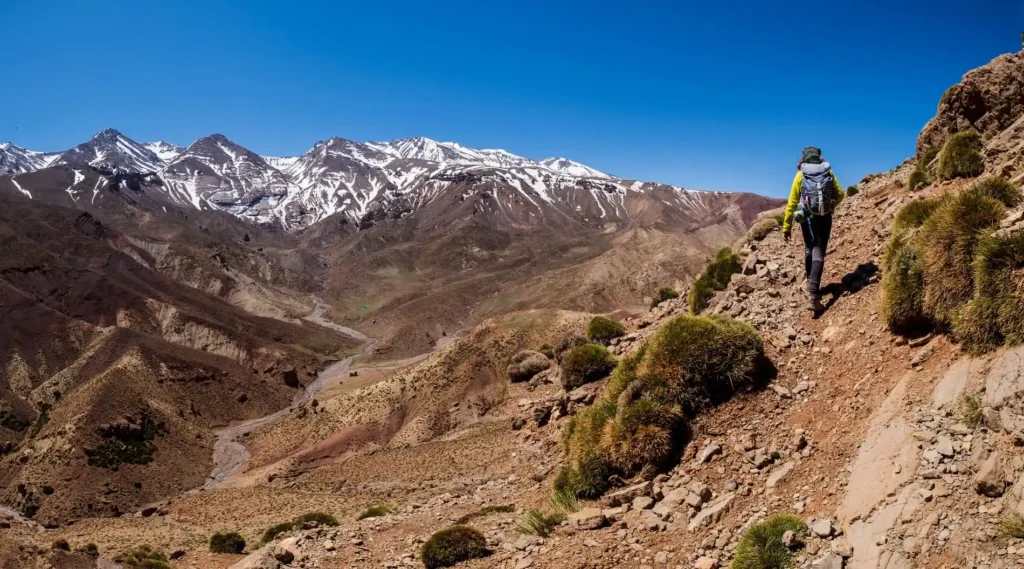
If you are looking for a M’Goun trek Morocco experience that takes you deep into the Central High Atlas — past terraced Berber villages, across high passes above 3,500 metres, and into the heart of Aït Atta nomadic territory — this guide is for you.
Jbel M’Goun (4,068 m) is Morocco’s third-highest peak and the centrepiece of one of the most rewarding multi-day treks in North Africa. Unlike the crowded Toubkal trail, the M’Goun Massif remains quiet, wild, and authentic. Here, the trails are unmarked in places. The shepherds still wear woollen djellabas. And the only sounds above 3,000 metres are wind and hoof-fall.
This guide covers everything you need to plan your trek: the geography and history of the valley, the best months to hike, a breakdown of routes by difficulty, what you eat and where you sleep, and why trekking with a local Berber guide is not optional — it’s essential.
We are Morocco Desert Gateway, a trekking-first boutique agency based in the regions we guide. Our guides are Aït Atta Berbers born into these valleys. We do not run bus tours. We do not cut corners. We run small-group and private treks on the exact trails described here.
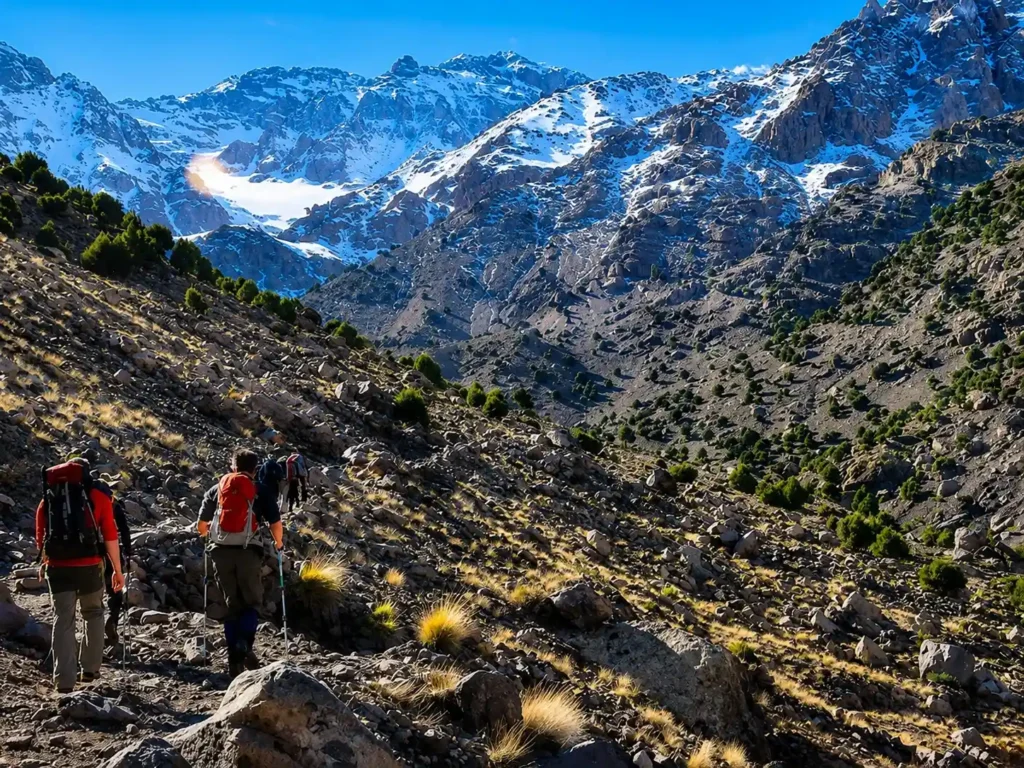
Table of Contents
- What Is the M’Goun Valley? Geography and History of the Aït Atta Nomads
- Best Time to Hike the M’Goun Valley
- M’Goun Trek Routes by Difficulty and Duration
- Food and Accommodation on the M’Goun Trail
- Why a Local Guide Is Mandatory for the M’Goun Trek
- Frequently Asked Questions
What Is the M’Goun Valley? Geography and History of the Aït Atta Nomads
The M’Goun Valley is not a single valley but a network of high basins, gorges, and plateaus centred around the M’Goun Massif in the Central High Atlas. The region stretches roughly from the Aït Bougmez Valley (locally called the “Happy Valley”) in the north-west, across the Tarkeddit Plateau, and down through the dramatic M’Goun Gorge to the Rose Valley near El Kelaa M’Gouna.
A landscape carved by time
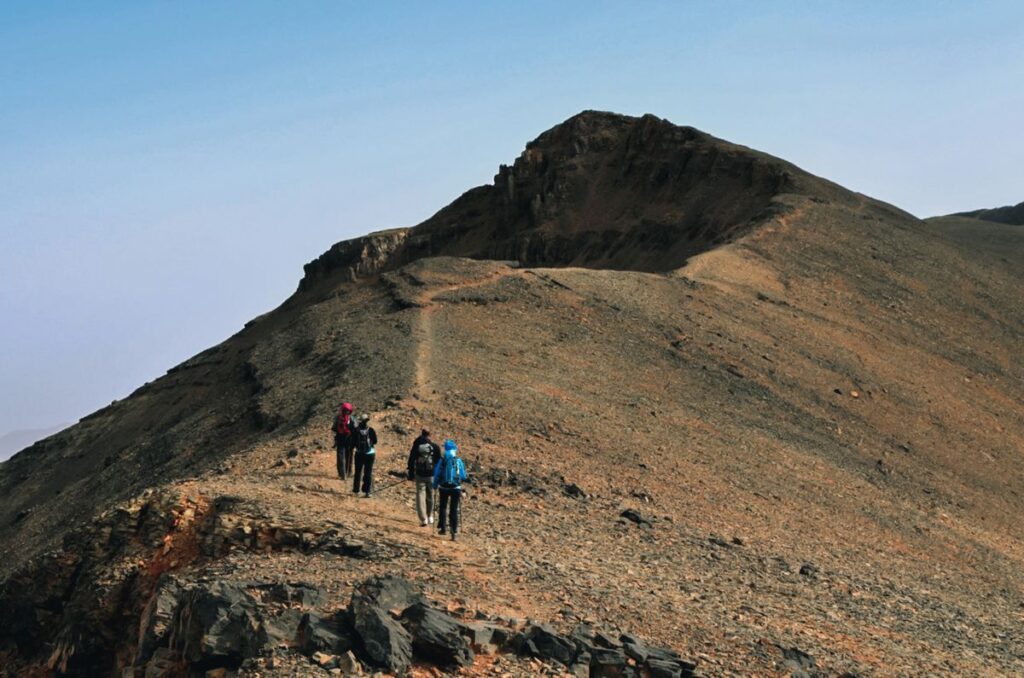
The massif is a broad, ancient dome of limestone and volcanic rock, shaped by glaciation and erosion into high-altitude plateaus (what geographers call tarkeddit in Tamazight) and steep-cut canyons. The summit of Jbel M’Goun at 4,068 metres is not a sharp peak like Toubkal but a long, whaleback ridge that stretches several kilometres — a summit day that rewards with views across the entire Atlas range and, on clear mornings, a faint haze that marks the Sahara.
The Aït Atta: guardians of the High Atlas
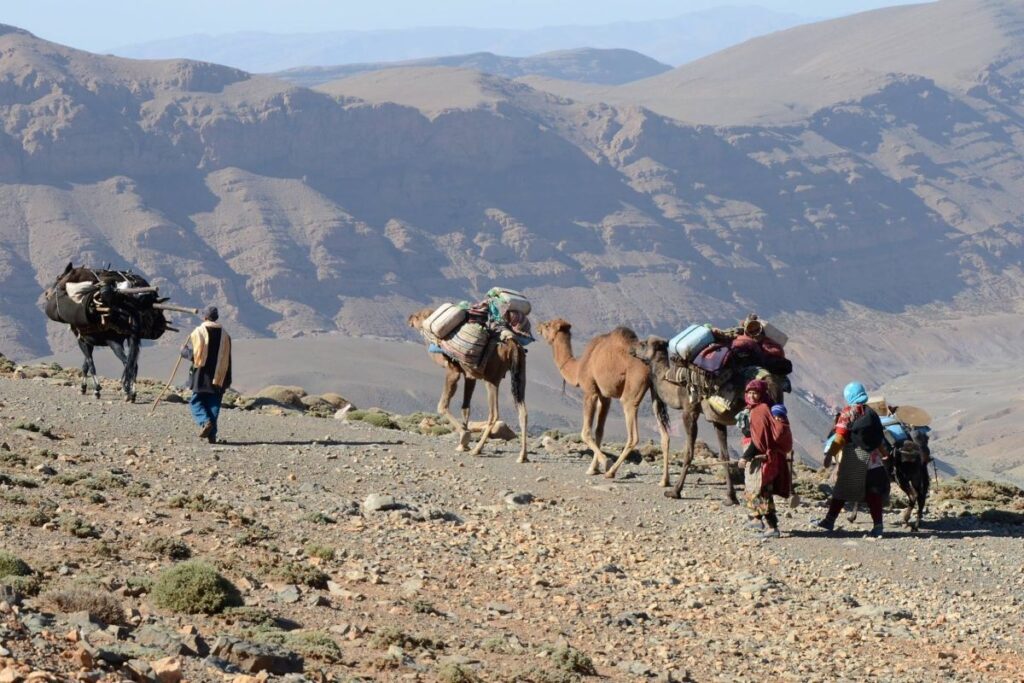
The human story of the M’Goun Valley is the story of the Aït Atta, a Berber tribal confederation that has inhabited this territory for centuries. The Aït Atta follow a seasonal pattern of transhumance — wintering in the Jbel Saghro foothills and the Dades Valley, then moving their herds of goats, sheep, and the occasional camel up into the High Atlas summer pastures as the snow melts.
Trekking through M’Goun today, you still walk alongside this rhythm. In June and July, you will pass tented encampments at 2,800 metres where Aït Atta families live for weeks at a time, making cheese, weaving woollen rugs, and tending livestock. These are not tourist displays. This is a way of life that predates the French protectorate, the modern Moroccan state, and the concept of trekking itself.
The Aït Atta were the last Berber tribe to submit to French colonial forces, holding out in the Jbel Saghro until the Battle of Bougafer in 1933. That fierce independence is still visible in the direct, open manner of the people you meet on the trail.
Best Time to Hike the M’Goun Valley
The trekking window for a M’Goun trek Morocco is wider than many people think — but you need to choose your month carefully depending on what you want.
| Month | High Pass Conditions | Summit Feasibility | Crowds | Recommendation |
|---|---|---|---|---|
| October | Clear, stable | Good | Low | ★★★★ Best |
| November | Cool but stable | Good for fit trekkers | Very low | ★★★ |
| December–February | Snow possible above 3,200 m | Challenging, requires winter gear | None | ★★ Only for experienced |
| March | Snowmelt begins, muddy | Tricky above 3,500 m | Low | ★★ |
| April | Wet snow, some trail closures | Difficult | Low–moderate | ★★ |
| May | Clearing, wildflowers begin | Feasible from late May | Moderate | ★★★ |
| June | Excellent | Best | Moderate | ★★★★ |
| July–August | Hot in valleys, good up high | Good, afternoon storms possible | Highest | ★★★ |
| September | Excellent | Best | Moderate | ★★★★ Best |
Our recommendation for most trekkers: The sweet spot is mid-September to late October or May to June. In September and October, the days are warm (20–25 °C at lower elevations), the nights are cool (5–10 °C at camp), and the skies are reliably clear. Spring (May–June) brings wildflowers to the Aït Bougmez Valley and the high plateaus, though some passes may still hold snow into early May.
Winter trekking (December–February) is possible for experienced groups with proper cold-weather gear. The Jbel Saghro and lower Dades Valley remain accessible and offer a different, stark beauty. The M’Goun trek Morocco in winter requires a guide who knows the snow lines and the safe refuges — exactly what our Aït Atta guides do every season.
M’Goun Trek Routes by Difficulty and Duration
The M’Goun Massif is not a one-route destination. Here is a realistic breakdown of the main options, from a short introduction to a full traverse.
Easy / Moderate (no summit)
2-Day: N’Kob to Boumalne Dades via the Draa Valley foothills
A gentle introduction to the southern flank of the massif. Walks of 4–5 hours per day through palm-fringed valleys and kasbah ruins. Suitable for fit beginners.
→ Link: Our 2-Day N’Kob + Draa trek
3-Day: Dades Valley loop via N’Kob
Crosses the Tizi n’Ouano pass at 2,400 m. Nights in family-run gîtes. Good cultural immersion without high-altitude demands.
→ Link: Our 3-Day Dades Valley trek via N’Kob
Moderate / Challenging (some high passes)
4-Day: Dades Gorge to Merzouga via the M’Goun foothills
Combines a taste of the mountain scenery with the desert finish. Includes a night in a Berber gîte and a night in a Merzouga camp.
→ Link: Our 4-Day Dades + Merzouga tour
6-Day: Jbel Saghro crossing
A different landscape entirely — volcanic rock formations, deep canyons, and the lunar landscape of the Saghro massif. Moderate difficulty, 5–6 hours walking per day.
→ Link: Our 6-Day Jbel Saghro trek
Challenging (high altitude, summit attempt)
8-Day: M’Goun Valley + Merzouga
The ideal itinerary for most experienced trekkers. You trek from the Aït Bougmez Valley across the Tarkeddit Plateau (2,900 m), summit M’Goun (4,068 m), descend through the M’Goun Gorge, then transfer to Merzouga for the desert leg. Two distinct landscapes in one trip.
→ Link: Our 8-Day M’Goun + Merzouga expedition — this is the one.
9-Day: Full M’Goun traverse — Aït Bougmez to Dades
The complete crossing. Starts in the Happy Valley, crosses Tizi n’Ougane pass (3,550 m), summits M’Goun, and descends through the Dades Valley. Nine days, eight nights. Max altitude 4,068 m. This is the most complete M’Goun experience available.
→ Link: Our 9-Day M’Goun full expedition
Summit difficulty
The M’Goun summit day is non-technical but strenuous. You start between 4:00 and 5:00 AM by headlamp, climb through scree and rocky terrain for about 4–5 hours, reach the broad summit ridge, and traverse to the high point at 4,068 m. The descent takes another 3 hours. Total elevation gain on summit day: approximately 1,100 metres. Previous hiking experience at altitude is strongly recommended.
Daily walking range: 4–8 hours depending on route and summit day.
Highest point: Jbel M’Goun, 4,068 m.
Technical requirements: None at standard grade. Crampons and ice axe only needed if trekking in winter or early spring when snow covers the upper slopes.
Food and Accommodation on the M’Goun Trail
What you eat
A well-organised M’Goun trek Morocco includes all meals prepared fresh on the trail by your trek cook. Here is what a typical day of eating looks like:
Breakfast: Fresh bread baked over the fire, spreads (honey, argan oil, jam), omelette or msemen (Berber pancakes), mint tea, and coffee.
Lunch (picnic on the trail): Bread, tinned fish or cheese, olives, seasonal fruit (oranges in winter, apricots in summer), nuts, and dates. Your guide picks a scenic spot with shade and running water if available.
Dinner: The main meal is cooked in the evening — typically a tagine (chicken, beef, or vegetable depending on the day), couscous on special nights, or a hearty harira soup in colder months. Fresh salads made from market vegetables always appear first. Dessert is seasonal fruit.
Important: Good operators cater to dietary restrictions. Morocco Desert Gateway’s cooks handle vegetarian, vegan, and gluten-free requirements without fuss. Tell us in advance.
Where you sleep
Accommodation on a M’Goun trek Morocco follows the terrain:
- Gîtes d’étape (mountain guesthouses) in villages like Tabant, Aït Bougmez, and Boutaghrar. These are simple, family-run lodgings with shared bathrooms, foam mattresses, and home-cooked meals. Basic but clean and welcoming.
- Camping at high altitude. You sleep in two-person dome tents pitched by your mule team. Mattresses are provided. You need your own sleeping bag (rated to 0 °C for most seasons).
- Refuges — the Tarkeddit refuge at 2,900 m is a stone hut with basic bunks and a fireplace. Used on the standard 6–8 day routes.
What to expect at a Berber gîte: The host family will welcome you with mint tea. Shoes off at the door. You sit on floor cushions around a low table. Dinner is communal. After dinner, someone will bring out a lutar (traditional Berber flute) or tell stories. The experience is part of the trek, not a hotel stop.
Why a Local Guide Is Mandatory for the M’Goun Trek
Let us be direct: you should not attempt a M’Goun trek Morocco without a local guide. Here is why.
1. The trails are unmarked
Unlike the well-signed Toubkal routes, the M’Goun Massif has few waymarkers. Trail finding relies on reading the terrain — knowing which dry creek bed is the right one, which notch in the ridge is the pass, and which rock cairn indicates a route rather than a false lead. Satellite imagery does not tell you about washouts, recent rockfall, or which shepherd has moved his camp and taken the seasonal trail with him.
2. Weather changes fast above 3,000 metres
In the Central High Atlas, a clear morning can become an afternoon thunderstorm by 2:00 PM. Snow can arrive in September. A local guide reads the cloud formations and knows when to push on and when to pitch camp early. That experience saves lives.
3. The cultural dimension
The M’Goun Valley is not a museum. It is someone’s home. When you trek with an Aït Atta guide, you are walking with a member of the community whose family has lived in these mountains for generations. You gain access to gîtes that do not advertise, invitations to drink tea in family homes, and explanations of local customs that no guidebook captures.
An Aït Atta guide knows which village owns which stretch of pasture. They negotiate with shepherds for camping rights. They introduce you in Tamazight. The difference between a guided M’Goun trek and an independent attempt is the difference between visiting a place and being welcomed into it.
4. Legality and permits
Since 2018, Moroccan law has required foreign trekkers to be accompanied by a licensed mountain guide on High Atlas treks. Certified CFAMM guides (the Moroccan guide association) are the only authorised professionals. Morocco Desert Gateway works exclusively with CFAMM-certified guides from the Aït Atta tribe.
5. Safety and logistics
Mules carry your gear. The cook prepares your meals. The guide navigates. Without a support team, you carry everything — tent, food, stove, water — for 5–9 days at altitude. This is physically unrealistic for most trekkers and undermines the experience. With a team, you walk with a daypack and enjoy the mountains.
Frequently Asked Questions
Is the M’Goun trek harder than Toubkal?
Not technically, but it is longer and more remote. Toubkal is a 2-day up-and-down. The M’Goun trek requires 6–9 days. The summit day is less steep than Toubkal’s final push, but the overall endurance demand is higher.
What fitness level do I need for a M’Goun trek Morocco?
You should be comfortable walking 5–7 hours per day on uneven terrain, with a daypack of 5–8 kg. Training with hill walks, stair climbing, or a treadmill incline setting for 8 weeks beforehand is recommended.
Do I need to bring camping gear?
No. Your trek operator provides tents, mattresses, cooking equipment, and all meals. You need a sleeping bag (rated to 0 °C), a headlamp, waterproof layers, trekking poles, and sturdy boots.
Can I summit M’Goun in winter?
Yes, but only with an experienced winter guide and proper gear (crampons, ice axe, four-season tent). Most operators, including Morocco Desert Gateway, only offer winter M’Goun treks to small, experienced groups on a custom basis.
Is the water safe to drink on the trail?
Stream water is generally clean at altitude in the High Atlas, but giardia exists. Bring a filter or purification tablets. Your guide will also carry bottled water for cooking and drinking at camp.
How do I get to the M’Goun Valley from Marrakech?
The drive to the trailhead (usually Tabant in the Aït Bougmez Valley) takes 4–5 hours by 4×4 via Azilal. Morocco Desert Gateway includes transfers from Marrakech in all trek packages.
What is the difference between the M’Goun Valley and the Dades Valley?
The M’Goun Valley is the high mountain area — altitude 2,000–4,068 m, where the trekking happens. The Dades Valley is the spectacular gorge and river valley to the south-east, used as the exit route and often combined into the same trip.
What makes Morocco Desert Gateway different from other operators?
Our guides are Aït Atta Berbers born in the M’Goun region. We do not sub-contract. We operate our own trek logistics. We cap groups at 12 people max, and we run private treks for couples. We have been running M’Goun treks since before the massif appeared in mainstream travel guides.
Conclusion
A M’Goun trek Morocco is one of the finest multi-day hiking experiences in North Africa. You walk through living Berber landscapes — across high plateaus where the Aït Atta still graze their herds, past fossil beds that tell the geological story of a sea that once covered the Atlas, and up a broad summit ridge that gives you the High Atlas from end to end.
The key to doing it right is preparation: choosing the right season, understanding the routes, and trekking with a local guide who brings the mountains to life. The M’Goun Massif is not a sightseeing stop. It is a place you earn — step by step, pass by pass.
We built Morocco Desert Gateway around this philosophy: that the best way to experience the M’Goun Valley is on foot, accompanied by Berber guides who grew up on these trails, in small groups that leave no trace.
Ready to plan your M’Goun trek?
Browse our 8-Day M’Goun Valley Trek + Merzouga — our signature itinerary — or contact us to discuss a custom private trek. We will match you with the route that fits your experience, your season, and your ambition.
→ Explore all Morocco Trekking Tours
→ Discover the M’Goun region deeper